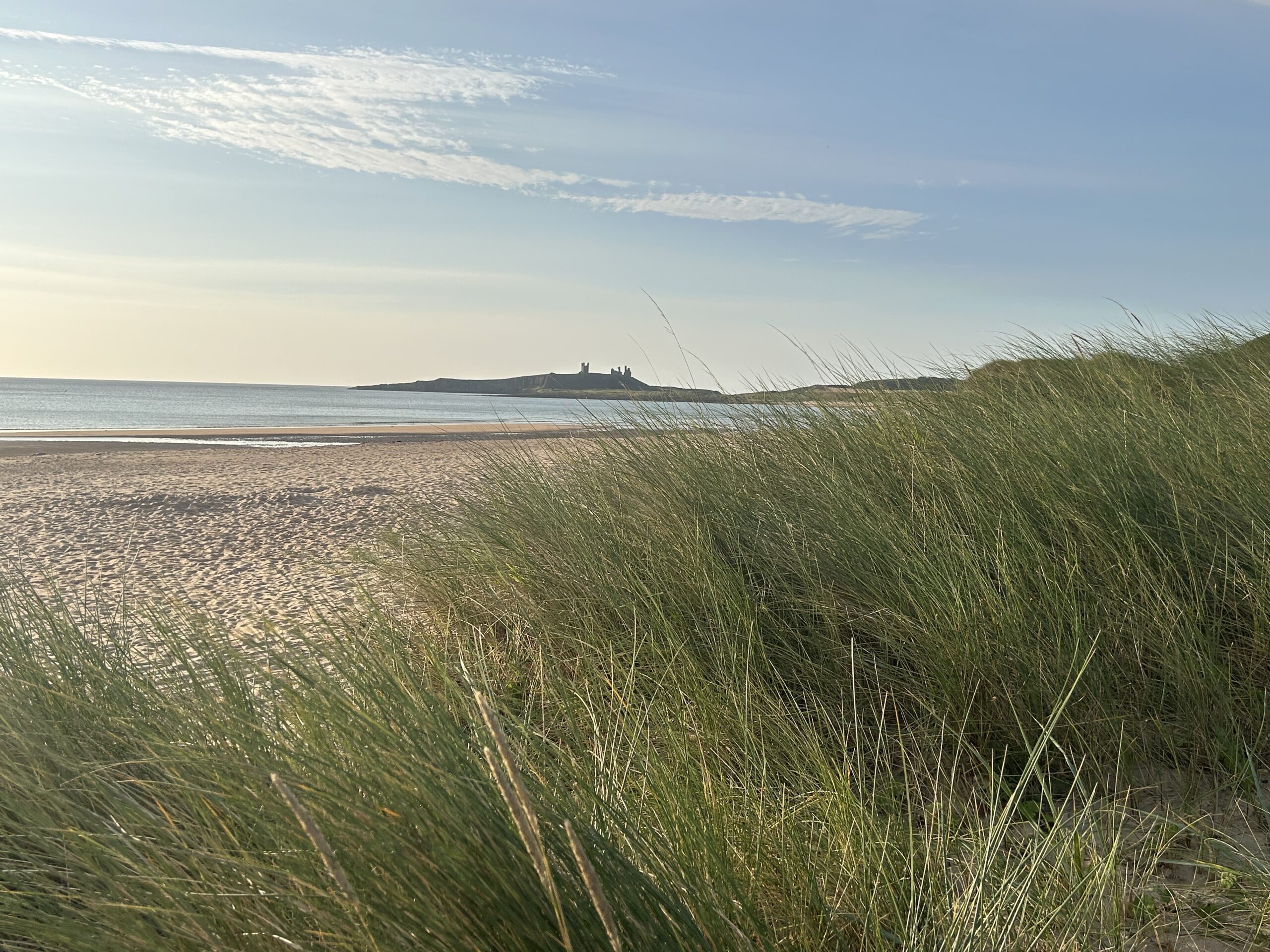

When golfers compile their bucket list of golf courses they one day aspire to tee it up on, I imagine topping the bill for most are the likes of the Old Course or Pebble beach. But the course that sits on top of my list is not one that has hosted Major championships or one that is thronged daily by lines of eager guests. It is a course in the far north east of England in the Kingdom of Northumberland. Set aside the wild waters of the north sea, mountainous sand dunes slowly crafted over time, all watched over by the looming ruins of a 12th Century fortress is Dunstanburgh Castle Golf club.
So why is this course the one that tops the bill on this golfer’s hallowed list? For me its place is dictated by the feelings that are stirred not just when I picture myself playing the course but what’s stirred when I think of the course and how it knits into its surroundings, its history, my mind wondering back to a time pre dating the course and what that land could tell us of its past.
For me a golfer’s bucket list is in some way comparable to one’s taste in music, everyone has their own ‘sound’. It is something that is completely personable to them and driven by the feelings you get when you hear those favourite songs.
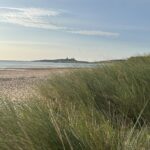
My feelings are amplified by my family’s connection with the area. Me, my partner and our children have spent many a weekend making the 6 hour round trip visiting the delights of England’s ‘Border County’ for the very reason Dunstanburgh sits at the top of this list. We love the place, the serenity we feel when we pass the Welcome sign is one of feeling at home, at peace with the world. It was on one of these weekends when I first set eyes on the Links. Walking down the aptly named Sea lane from the Village of Embleton, I had seen the signs for a golf course that I needed to investigate. However when we looked down from the hill at the top of the lane my eyes initially skipped straight over the views of the course, taken away by the magnitude and beauty of the area. Imposing Sand dunes, the spray from the waves crashing on the shore and then to the south the ruins of the former fortress of Dunstanburgh Castle perched on an outcrop of the Whin sill a layer of igneous rock that runs across the Northern Counties. My eyes then focussed on what sat inside all this beauty, as if someone had just dropped it from above and let it mold to the land. The golf course.
The course was first established on the links in 1900 and was originally opened to provide entertainment for guests at the nearby Dunstanburgh Castle Hotel. It was in 1919 that Sir Arthur Munro Sutherland purchased the estate. His plans were to remodel the original nine, this was then followed by an extension to 18 holes. In 1920, James Braid began his input, however the course ultimately took another two decades to complete.
Upon your arrival, the course sprawls across natural links land on both sides of the lane you traverse down to the clubhouse. The first 6 holes of which only 2 are visible lay to the left with the remainder of the course filling the land toward the castle to your right. The first 6 holes are also split into 2 sections, those holes below the dune on those played on it.
Your opening tee shot is played towards a green tucked in the shadows of the great dune that you then climb to play the next 4 holes, which map their way around its summit. You then face a tee shot from the summit giving a birds eye view of the course. You are flanked by more dunes and the North Sea to your left and out in the distance you can make out the ruins of the castle which you slowly work towards. As you play your way toward the Castle the dunes pinch to your left with the sound of waves crashing on the shore and depending on the time of year, and tide , families frolicking upon the beach beyond the dunes or walking the coastal path amongst the dunes on their own adventures towards the Castle.
Whilst playing the holes that hug the sea there is a sombre feature that provides a nod to more troublesome times. It lays beyond the green on Hole 10 giving the hole its name. An old wartime ‘Pillbox’ stands resolutely on the edge of the dune looking out to the sea beyond. Put in place as part of fortification of this section of the Northumbrian coast in fear of invasion it now provides a backdrop to the opening hole of the back 9, providing a stark reminder just how lucky we are to have an opportunity to spend our free times enjoying this pastime earnt on the back of sacrifices made by those brave souls who stood up to tyranny. Given the current climate of the world we live in let us hope such sacrifices should never be needed to be made again.
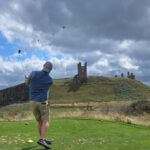
The culmination of the march towards the fortress rewards you with the 14th, the signature hole of the course. You hit over a ravine carved from an offshoot of the igneous rock toward a postage stamp green. Trouble guards all sides of the green with the ravine covering the front, hugging the left you have the coastal path which follows the edges of small cliffs with the sea waiting below. Beyond the green and to the right a field lays waiting for any balls heading their way out of bounds. The coastal path flags round the ravine then takes its path to the left, meaning on a summer’s day plenty of walkers will be in attendance to watch your attempts to conquer the hole. All this is played out below the looming presence of the castle, from its position high above watching over your attempts.
After you have failed or succeeded your assault on the castle hole, you then make the turn towards home. This homeward stretch takes you away from the dunes as you hug the fields that neighbour the course on your left.
The first challenge you face on this stretch is the only par 5 on the course, calling for a driver threaded between fairway bunkers. Any bail outs left or right will be swallowed up by either the out of bounds to your left or the long,wrist breaking grass that forms its own defence all the way up the right side of the hole.
Your next challenge is a short par 3 named Basin. The short nature of the hole looks a welcome break on the scorecard, however this is short lived when you see the complexity of the tee shot you face, although not as imposing as what you faced on 14 it is as equally challenging. Anything short will find its way either into the greenside pot bunkers or continue down the slope, where if you’re lucky, your ball will roll into and hold up in the rough or for those less fortunate will end up in the little burn that runs across the hole.
You then face 3 stout par 4s, not giving any respite at the closing moments of your round. Finishing with what I considered the hardest hole on the course, the 18th. Following the theme which runs through all the holes post hole 14 you are required to thread your drive between fairway bunkers, out of bounds left and thick troublesome grass to your right. The approach shot is then hit towards a green guarded by a burn to the front which then turns to the left of the green to form part of a bigger hazard. There are then 2 pot bunkers to the right of the green ready for anyone who plays too safe away from the hazard.
This course is the most complete course I have ever played. It felt an equal match of challenging and fair, if you play to the right areas you are rewarded if not you are penalised just as golf should be. I can not speak highly enough of my experience, if this was a course 40 miles up the coast in Scotland it would be one that would be on the bucket list of many worldwide golf tourists. So for those who are interested please take the time to visit and let me know what you think.